A leading global supplier of industrial trucks, warehouse technology and automation solutions was faced with the challenge of further developing its product development process (PDP). Although the existing process was established, it was no longer up to date after six years. In the meantime, technological possibilities, organizational structures and market requirements had changed considerably: The digital transformation picked up speed, transparency and time-to-market became more important - and the company grew into a full-service intralogistics provider through international expansion and the integration of new business areas.
Initial situation
for global requirements and higher market dynamics
Our customer - one of the world's leading suppliers of industrial trucks, warehouse technology and automation solutions - had an established product development process (PDP) that was around six years old at the start of the project. A lot had changed during this time: The process landscape had been further developed, new digital technologies were coming into focus and the requirements for speed and transparency were increasing. At the same time, the organization had become more internationalized and professionalized - including through the integration of companies that cover all dimensions of intralogistics.
The challenges were manifold:
- The time-to-market had to be significantly reduced.
- Different PEP logics for machine and system development made collaboration difficult.
- Specialist departments often worked in separate tracks - genuine cross-functional project work was the exception.
- Responsibility in projects was often diffuse - despite clear processes.
The central question was: What can a future-proof PEP look like that works globally and also meets the real requirements of day-to-day business?
From process to mindset:
The PEP as a driver for real project responsibility
Our approach
We started with an in-depth analysis - together with the specialist departments. In SIPOC workshops, we made the existing processes, interfaces and frictional losses visible. It quickly became clear that the new PDP had to be more than just a revised process. It must promote a new mindset - with genuine project responsibility, integrated planning and a clear focus on results.
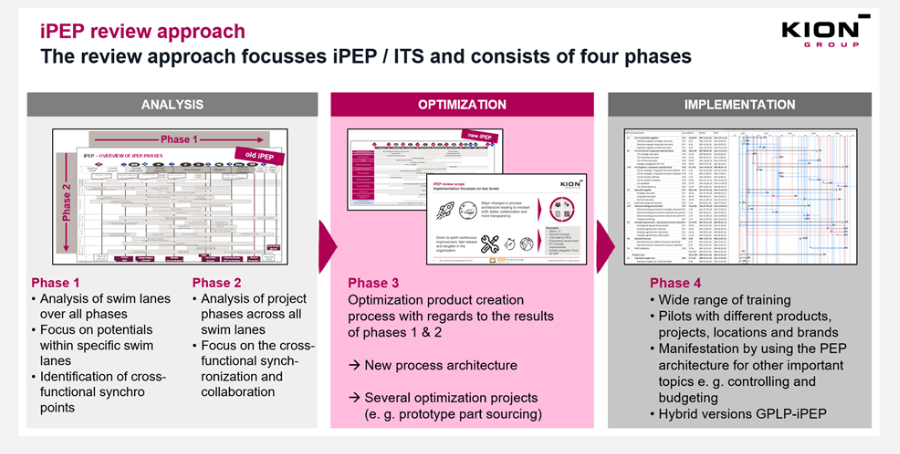
Three levers for effective change:
Structure, clarity and joint action
1. structural reorganization:
- Dissolution of the classic divisional paths and conversion to cross-functional value streams, e.g. parts procurement as a joint process of development, purchasing, quality, logistics and production.
- Integration of perspectives from machine and system development in a consistent model.
2. become more concrete, create clarity:
- Deliverables were no longer defined by activities ("plan created"), but by their impact and relevance in the project ("critical path understood, measures set up").
- Each deliverable was given clear acceptance criteria and a defined responsibility.
3. integrated project planning and working with premises:
- Traditional planning was replaced by a joint, cross-team approach with premises.
- Risks were no longer seen as a "reporting obligation", but as a starting point for active management.
- A key innovation was the introduction of regular scheduled meetings in which project teams jointly reflect on planning, premises and progress.
A tailor-made tailoring concept was also introduced: the PDP was adapted depending on the product, market and project risk - as much as necessary, as lean as possible.
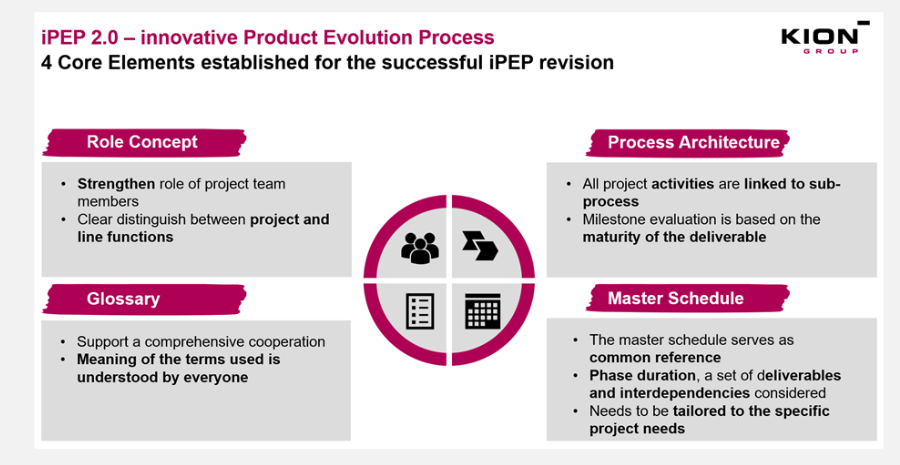
Piloting & rollout
The new PEP anchored in real day-to-day project work
The new PEP was not implemented on the drawing board. It was developed, piloted and continuously improved together with customer teams - on real projects, with real challenges. Pilots took place at the most important development locations: in Germany, France, Italy and China.
Training and change measures:
- Multi-day training courses for all roles that combined methodological depth with active application
- Accompanying coaching of project managers and decision-making bodies
- Integration into the existing tool world
- Training videos and roadshows for sustainable anchoring
A particularly formative moment:
In a role training session, a line manager actively supported the participants - and recognized in dialogue how much his leadership behaviour would change if he delegated real project responsibility. This scene was so authentic, open and entertaining that it became a "running gag" - and at the same time a symbol of change.
Results
15% faster to market -
with more clarity, responsibility and team spirit
The effect of the new PEP became apparent quickly and clearly - both in figures and in the way we work together:
- Reduction in time-to-market by 15% - without compromising quality
- Significantly fewer SOP delays because risks were identified and managed earlier (e.g. by reducing the number of variants in the start-up phase)
- Higher success rate in milestone decisions because the basis for decision-making was clearer and more reliable
- More motivated teams because responsibility was handed over in a tangible way
- Expansion to include start-ups that were acquired during the project - the new PEP was flexible enough to integrate new companies quickly
- Improved integration of hardware and software development through joint release planning
What made CO Improve stand out
More than consulting: three years of change at eye level
The collaboration with the client over three years was intensive, based on partnership and characterized by mutual trust. We were perceived as part of the organization - not as external consultants.
What was particularly appreciated:
- Our consistent focus on solution-oriented implementation instead of methodological dogma
- Our ability to make changes compatible - culturally, linguistically, organizationally
- Our intercultural expertise - especially in the USA and China
- And last but not least: the language we speak - clear, direct, in partnership
The feedback
"You don't do it by the book - you do it in a way that suits us." (echoed by many of the customers involved)
Our Customer
Your satisfaction

Our projects
Case studies for you