
For several years now, we have been able to support a medium-sized high-tech company as a trusted advisor in the continuous improvement of product development performance. The starting point was a holistic inventory of all potentials in a Smart Development Assessment. This was followed by the introduction of project portfolio management, an interdisciplinary product development process, professional project management and agile working methods. Now the next booster to increase performance was to be ignited with a redesign of the organisational structure. The company opted for a project organisation. You can find out why this decision was made in the following project report.
Project organisation as a performance driver
Motivation
The central question was whether an increase in performance could be achieved by harmonising the needs of the company in terms of greater customer focus, speed and efficiency with the needs of the employees. From the various basic organisational alternatives, the project organisation quickly emerged as the most effective form of organisation. It combines elements of modern agile organisational structures with the classic project implementation still desired here.

Needs of the employees
Knowledge workers today are considered to be intrinsically motivated. A company can develop this intrinsic motivation by creating the right framework conditions and managers leading their employees with a catalyst leadership style: The factors mentioned are Meaningfulness (Purpose), Automomy (Autonomy) and Perfection (Mastery). In discussions with employees and applicants, the company also highlighted the simplicity factor of the organisational structure. "Employees are simply fed up with complex, multi-dimensional matrix organisations".

The project organisation
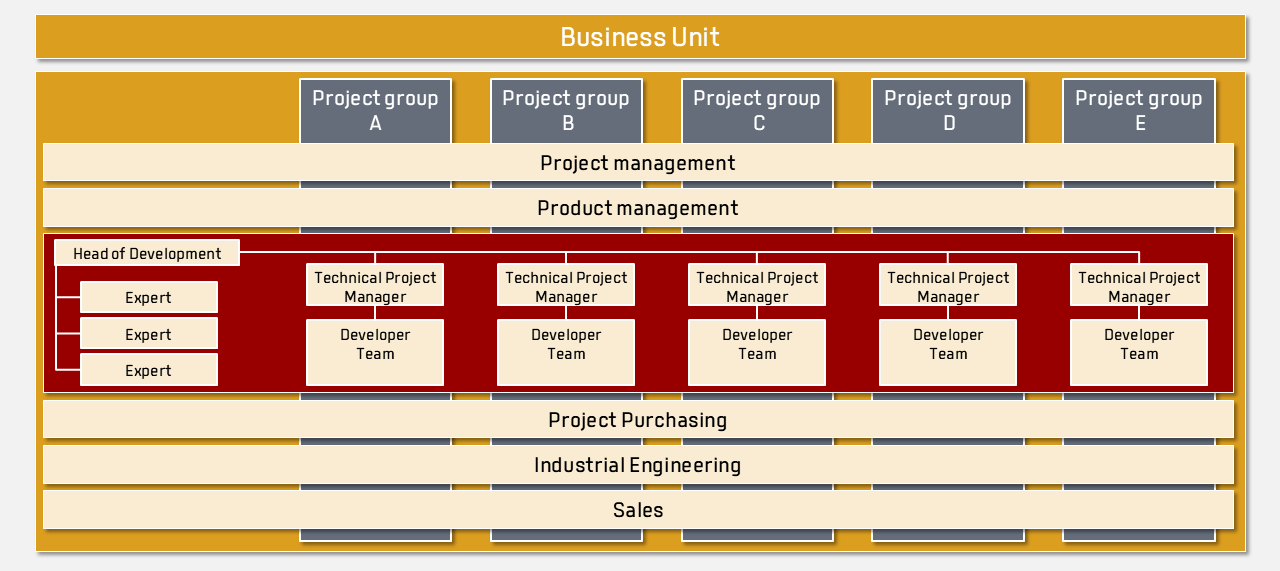
The new organisation should meet these needs. The project was chosen as the primary structuring feature. Developers work almost exclusively in projects. The resulting basic structure provides for a flat hierarchy with business units and interdisciplinary project teams. The business unit managers thus have all the important specialist functions for sales, the design of the product strategy and the prioritisation and implementation of interdisciplinary projects on board, including all developers.
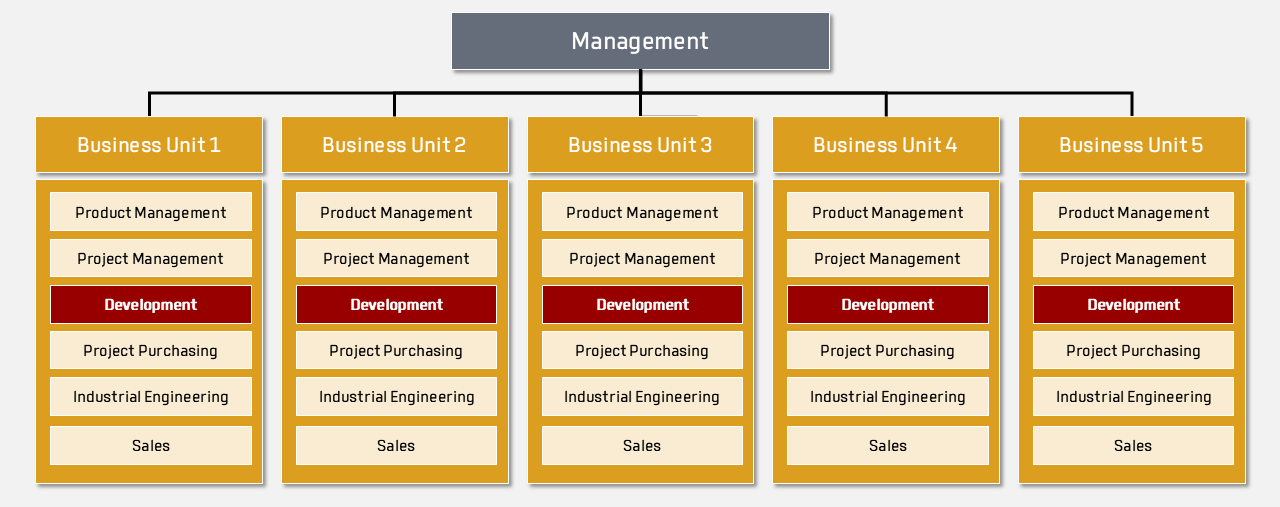
With the exception of a few central service functions, the approximately 200 developers were assigned entirely to the business units and permanently to project teams within the business units. In addition, experts were introduced to support the project teams as required.
Harmonisation of company and employee needs
Meaningful organisation:
Greater identification, autonomy, excellence and simplicity for employees
How does the new organisation meet employees' needs for meaningfulness, autonomy, perfection and simplicity?
Meaningfulness
The permanent assignment to a business unit, in this case a sector, increases the employees' identification with the customers and their requirements. Developers understand much better which challenges and problems their development work solves for the respective customer.
Autonomies
The developer teams were put together in such a way that they can largely carry out their tasks without the help of other teams. At the same time, a role expectation was developed for the developers that focuses on motivation on the one hand, but on the other hand places significantly more emphasis on independent and self-organised work. The experts anchored in the organisation and working across teams should only be called in by employees when they have clearly reached their technical limits.
Perfection
The project teams are permanently anchored in the organisational structure. They therefore stay together, familiarise themselves, learn from each other and thus automatically increase their efficiency and performance on an ongoing basis. In addition, care was taken to ensure that employees also harmonise on a personal level.
Proven experts are deployed to increase innovation performance and technical expertise. There will be exactly one expert for each specialised domain. In future, they will be able to experience appreciation and recognition in a parallel expert career path without disciplinary responsibility for employees. The experts will organise virtual guilds (communities of practice) to increase knowledge development and perfection in the specialist domains.
Simplicity
Applicants from larger companies in particular had expressed their dissatisfaction with multidimensional matrix organisations. The company saw this as an opportunity to positively differentiate itself and thus increase its attractiveness as an employer. In fact, the disciplinary and project-related reporting lines will in future coincide for the individual developer. The technical project manager, who in practice works directly and most intensively with the developer, is now also their disciplinary superior with many advantages in terms of performance appraisal, employee development planning, holiday planning, etc. The professional reporting line has been significantly weakened. In future, technical coordination will take place on a collegial basis with the experts and in the self-organised guilds.
Approach
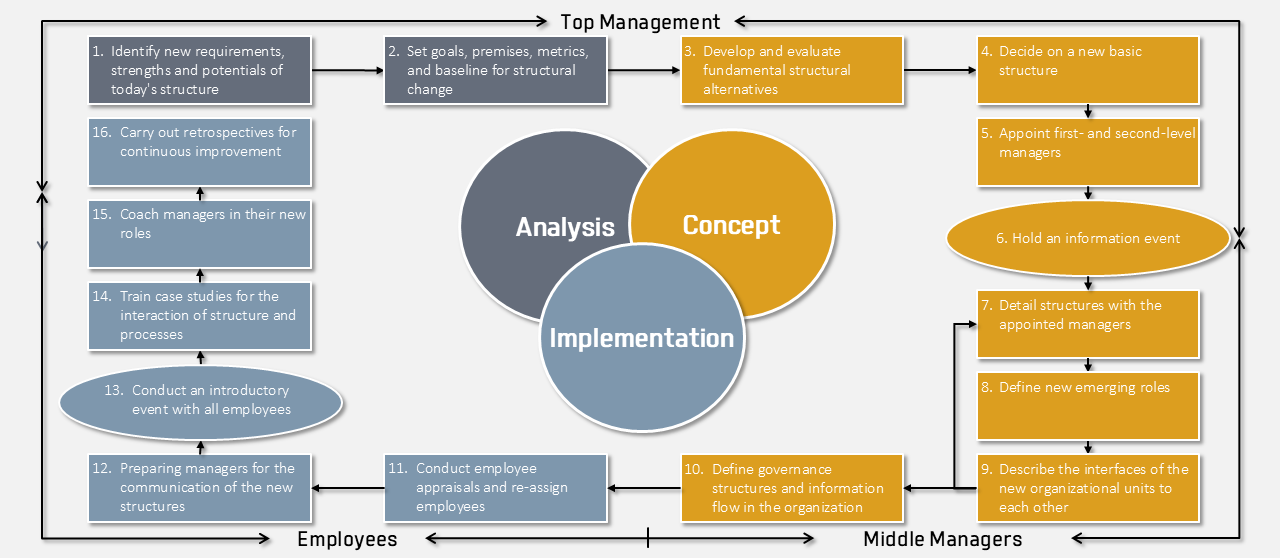
At CO Improve, we have developed and validated a process model in 25 years of consulting experience in many organisational projects. In doing so, we rely on intensive change management. We turn those affected into participants and those involved into supporters. In this way, we achieve irreversibly good results that sustainably increase performance.
Conclusion and outlook
Project organisation as the basis for high performance
and agile working tomorrow
With a project organisation, it is possible to harmonise the company's goals with the needs of the developers and thus create a high-performance organisation. At the same time, a very good starting point is created for the next step of converting traditional project work to agile working methods, thereby improving the prioritisation of projects and dealing more effectively with changing requirements.