You are a successful and growing company. In order to remain competitive, keep your competitors at bay and satisfy customer requirements, you have to develop and launch more and more new products in less time. So they are launching more and more new development projects. But the prevailing shortage of skilled labour makes it difficult to expand their development capacities, their time-to-market is getting longer, their product maturity at market launch is getting worse and their employees are suffering from permanent overload. Of course, they are constantly working on increasing the efficiency of their product development. Nevertheless, there is only one way forward: they need to carry out fewer projects at the same time. With efficient project portfolio management, they can direct their resources to the right development projects and at the same time prevent their pipeline from becoming clogged.
From component manufacturer to system provider
Success with a strong project portfolio
In this practical example, we report on a very successful medium-sized company in the heating, air conditioning and ventilation technology sector. A few years ago, the company - like many others - embarked on the path from component supplier to system provider. As a result, the proportion of software development, project complexity and the interdependencies between projects increased.
Even before that, low-priority development projects took far too long. Sometimes so long that the market requirements had already changed again. After a holistic location and potential assessment with CO Improve, various improvement initiatives were launched to increase efficiency. Among other things, we were able to support the company in designing and introducing an efficient project portfolio management system.
Extension to other product creation projects
Objective and solution approach
The following points were agreed as objectives for this initiative:
- Achieving the next strategically defined sales and return target
- Improving adherence to project completion deadlines
- Shortening time-to-market by optimising throughput
The solution was based on two approaches. Firstly, the strategically and economically important projects were to be reliably identified and selected. Secondly, it was necessary to have an overview of the resources still available in order to ensure the feasibility of the development projects within the desired time frame, at least in terms of planning. In detail, we needed
- Strategic budget allocation and control for defined value streams
- Efficient market intelligence and strategic product management
- Transparent criteria for assessing strategic importance and profitability
- Prioritisation across product segments
- A workload model
- Multi-project resource planning with a work-in-progress (WIP) limit
- An improvement to the existing process for project evaluation, prioritisation and approval
Procedure
An interdisciplinary team of company managers and experienced consultants from CO Improve was formed to develop the conceptual solutions. Sales, R&D, Purchasing, Controlling, PMO and IT were all involved. The concepts were developed in subgroups in joint workshops. To ensure rapid and efficient progress, CO Improve prepared concept drafts tailored to the company's situation, which were then jointly processed and further developed. The manageability of the individual solution elements was tested with those affected in the organisation using real examples and the feedback was taken into account for the final optimisation. Only then was the rollout included in the annual budget and project approval process.
At the start of the project, it was decided that, based on the existing project categorisation, only the "large" projects should be the subject of strategic project portfolio management. Smaller projects were to be approved on a decentralised basis by the division heads. A base load for these smaller projects is reserved and deducted from the capacities to be determined for the project resources.
Strategic budget allocation
To enable a strategically orientated allocation of resources for development projects and to ensure that not all projects compete directly with each other in the selection process, it was agreed to start budget planning firstly with a breakdown of the budget by business area (product group) and secondly with a breakdown of the budget by project type (pre-development, new product development and product maintenance).
As a result of the first agreement, some of the personnel resources previously allocated to the business divisions were transferred to centralised resource pools. Only in this way will it be possible to easily shift personnel resources in future if strategic priorities change. The implementation was realised in the parallel "Organisational Structure" initiative.
The budget allocation and ongoing monitoring by project type ensures that urgent product maintenance does not cannibalise new product development and that this does not cannibalise pre-development. It was supported by a further organisational measure, the introduction of a central pre-development area. This fulfils the company's strategic innovation requirements and safeguards the future return target.

Evaluation criteria
In the next step, we jointly designed a two-stage evaluation process for project evaluation and prioritisation. The aggregation of the evaluation takes place in a scoring model. Three criteria are assessed:
- profitability
- Strategic importance
- Risk
In order to assess profitability, a detailed business case template was developed, which depicts the sales forecasts and price trends in the various markets for the sales side and takes into account the development of manufacturing costs and individual project costs in a contribution margin calculation for the cost side.
Final is discounted with an imputed interest rate in order to calculate a net present value for each project and thus be able to compare projects directly with one another. Of course, the evaluation stands and falls with data quality. To this end, we had included powerful market intelligence and strategic product management in the solution approach. This requirement was also implemented in the parallel "organisational structure" initiative.
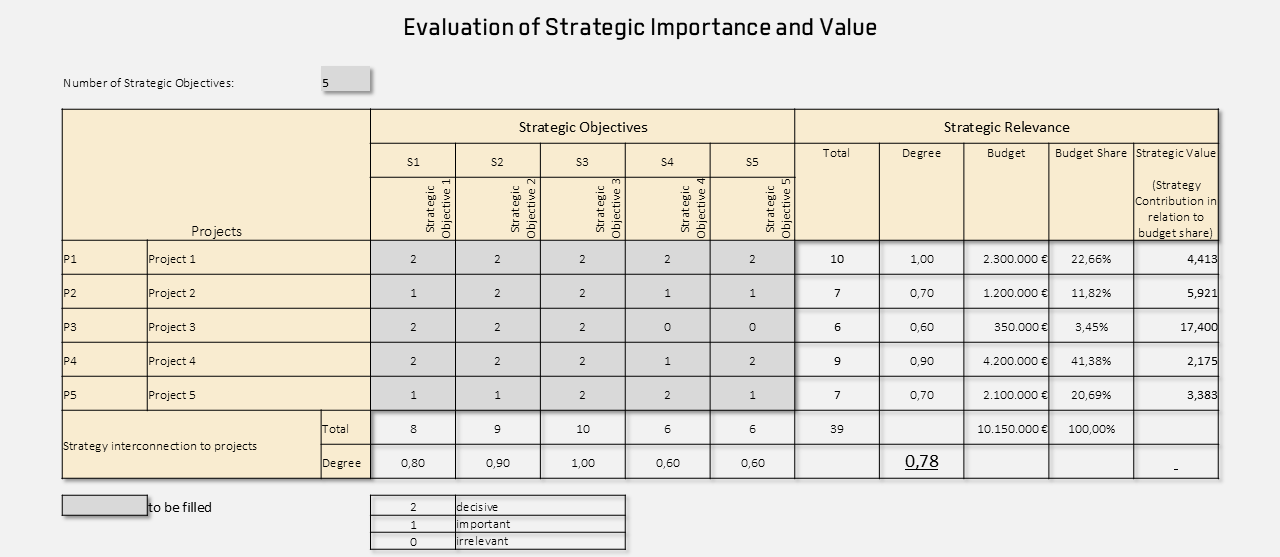
Discussing the strategic importance of a project is always difficult and often comes from the gut. This does not necessarily have to be wrong. The company has opted for a separate scoring model to objectively determine strategic importance. Here, the objectives of the corporate and product strategy are explicitly listed and the contribution of each project to the realisation of each strategic objective is evaluated. This results in a strategy contribution that can be used for the aggregating scoring model.
The risk assessment is again aggregated from various risks. Development risks are analysed in terms of technological maturity and functional validation already completed, market and sales risks and budget risks.
Workload model and multi-project resource planning
One major consequence of overstretching the available personnel capacities is harmful multitasking (Eliyahu M. Goldratt: Critical Chain). This multitasking further exacerbates the situation. A vicious circle is created.

But development projects are subject to a high degree of variability and unpredictable events. This is simply in the nature of things. In this respect, it is important to maintain buffers at the time of release in multi-project resource planning and to plan which projects can actually be started in the order of their prioritisation. It is illusory to optimise processes completely in terms of planning.
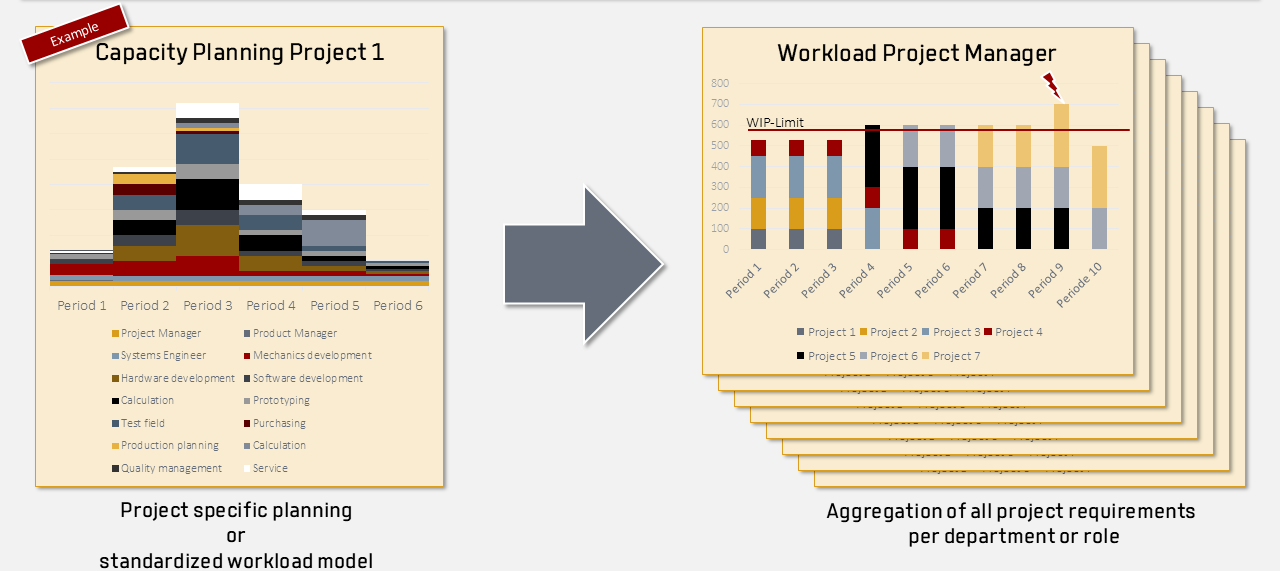
Experience has also shown that the aggregation of individual project plans is not successful or is too time-consuming. And often there is no project team in place at the time of project approval to carry out project planning. This inevitably requires separate project resource planning that is sufficiently accurate but not too time-consuming. Two alternatives are possible. The use of standard workload models or project-specific planning based on analogue considerations.
In this project, the company decided in favour of project-specific planning due to the large variance of the projects. To this end, we jointly defined project resource categories - 22 in the first step, a relatively high number. A month was chosen for the time resolution of the resource requirements. The responsible product area managers trialled the planning and assessed the effort involved as acceptable. In the future, the planning effort will continue to decrease because more project plans will be available for analogue considerations.
At the time of the project release decision, the future project plans created in the business units are aggregated in order of priority. As soon as the defined buffer of one of the 22 project resource categories is reached, the project cannot initially be released. Of course, increasing the capacity at the bottleneck point is a sensible reaction option.
Process
A process for annual budget planning and project approval with the necessary process steps and participants had already been defined and implemented in advance. It therefore only had to be adapted to take account of the new evaluation, prioritisation and planning methodology.
Conclusion
The new process has now been in use for several months in order to benefit from the expected advantages, gain experience and continuously improve the processes and methods. Of course, the capacity utilisation situation will not change abruptly. After all, a large number of development projects will not be stopped abruptly. Effects on time-to-market will only materialise in the medium term. Nevertheless, the first effects are already visible:
The requirement for the return on each individual project to achieve the company's return target was increased
- The return on investment of projects can be better determined with the new business case tool
- Awareness of the correlation between harmful multitasking and project runtimes is heightened
- Projects are jointly evaluated and prioritised by sales and development managers according to standardised criteria
- Projects are started taking into account a defined work-in-progress limit
- The cross-functional availability of resources is reviewed
Our customers
Your satisfaction